
News list
Recommended news
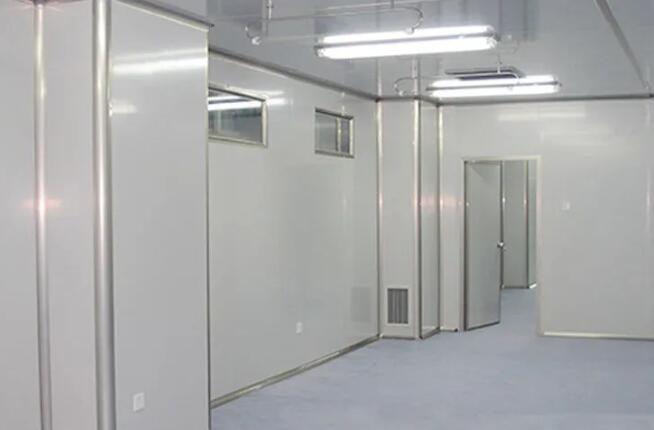 Building a dust-free workshop for medica
2024-02-01
 Design of Food Cleanroom
2024-02-01
Difficulties in Purification Engineering Construction |
Publisher:Suzhou Lingxi Purification Engineering Co., Ltd. │ Click count:394 │ Publication time:2024-02-01 14:47:17 │ close |
| Purification engineering is generally the construction of a clean room, also known as a clean room or clean room. It is the foundation of pollution control, and without a clean room, it is impossible to mass produce pollution sensitive parts. In FED-STD-2, a clean room is defined as a room with air filtration, distribution, optimization, construction materials, and equipment, where specific rules and operating procedures are used to control the concentration of suspended particles in the air, thereby achieving appropriate levels of particle cleanliness. Purification engineering is an engineering discipline that removes pollutants such as particles, harmful air, and bacteria from the air within a certain spatial range, and controls indoor temperature, cleanliness, pressure, airflow velocity and distribution, noise, vibration, lighting, and static electricity within a certain range of requirements. A room specially designed for purification engineering, regardless of changes in external air conditions, maintains the cleanliness, temperature, humidity, and pressure performance originally set. The main function of a clean room is to control the cleanliness, temperature, and humidity of the atmosphere in which products (such as silicon chips) come into contact, so that products can be produced and manufactured in a good environmental space. This space is called a clean room (i.e. purification engineering). 1. Demolition project Try not to use operations with "fire" as much as possible, especially when dismantling pipelines and exhaust lines containing flammable and explosive substances. It is strictly prohibited to use operations with "fire"; When it is necessary to use the "fire" operation, it should be confirmed that there are no problems after 1 hour before leaving the site. For demolition work that may cause vibration, coordination with relevant parties should be made in advance to determine the construction time. For partial demolition, when the remaining parts are not demolished or still need to be used, necessary testing work (flow rate, pressure, etc.) before system disconnection and demolition should be properly handled ; When disconnecting the power supply, an electrician must be present to handle safety and operational matters. 2. Air duct construction Strictly follow relevant regulations for on-site construction, and formulate construction and safety regulations based on the actual situation of the renovation site; Properly inspect and store the air ducts to be installed on site, keep the inside and outside of the ducts clean, and seal both ends with plastic film; When using expansion bolts for hoisting, there will be vibration. Prior coordination with relevant personnel such as the owner should be carried out: before hoisting the air duct, the sealing film should be removed, and the interior should be wiped before hoisting. Necessary protective measures should be taken to ensure that the easily damaged parts of the original facilities (such as plastic pipes, insulation layers, etc.) are not compressed. 3. Construction of piping and wiring Welding operations required for piping and wiring should be equipped with fire extinguishing equipment, asbestos boards, etc; Strictly follow the relevant construction acceptance standards for piping and wiring. If water pressure testing is not allowed in the vicinity of the site, air pressure testing can be used, but corresponding safety measures should be taken according to regulations; When connecting to existing pipelines, safety technical measures should be formulated in advance before and during the connection, especially for the connection of flammable, toxic gas, and liquid pipelines; During operation, safety management personnel from relevant parties must be present on site, and if necessary, fire extinguishing equipment must be prepared; In addition to complying with relevant regulations during the construction of pipelines for transporting high-purity media, special attention should also be paid to the cleaning, blowing, and purity testing of the original pipeline connections |

